 Pregnancy
20 Weeks Pregnant: Baby Development, Symptoms, Size and Appointments
Quick Answers at Week 20
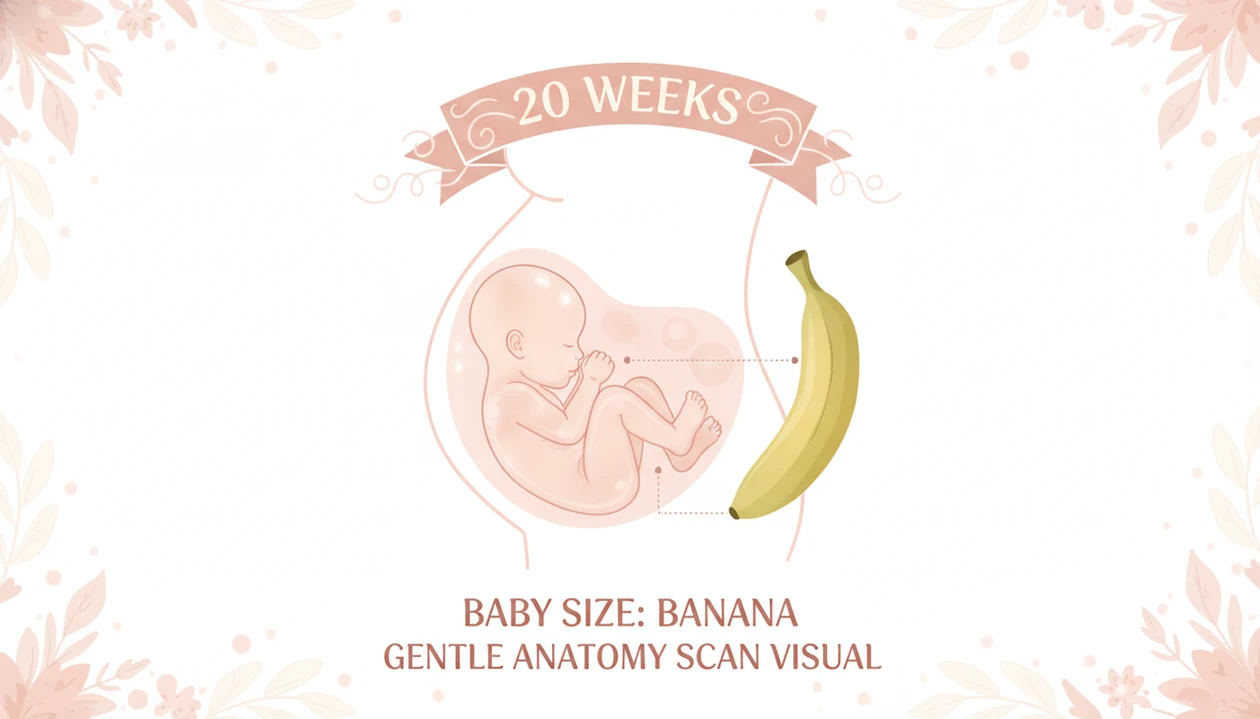
At 20 weeks pregnant, baby is about banana-length and this midpoint week often centers on the anatomy scan and more noticeable second-trimester body changes.
- Baby size: about 25 cm head-to-heel and roughly 280 to 320 grams on average
- Symptoms: growing bump, round ligament discomfort, backache, heartburn, constipation, leg cramps, mild swelling, first flutters
- Appointments: many clinicians review blood pressure, urine, weight, symptoms, screening results, and scan questions
- Ultrasound: the mid-pregnancy anatomy scan is commonly done between 18 and 22 weeks
Week 20 at a Glance
| Topic | Week 20 |
|---|---|
| Baby size | Often compared with a banana, about 25 cm head-to-heel and roughly 280 to 320 grams on average. |
| Ultrasound | The anatomy scan may check major organs, spine, limbs, growth, placenta location, amniotic fluid, and sometimes cervical length. |
| Symptoms | Common symptoms include a growing bump, ligament pain, backache, heartburn, constipation, leg cramps, mild swelling, and early movement sensations. |
| Appointments | Your OB-GYN or midwife may review scan findings, blood pressure, urine, weight, symptoms, and screening results. |
| Key milestone | You are around the halfway point of a typical 40-week pregnancy, counted from the first day of the last menstrual period. |
TL;DR
Week 20 is often the pregnancy midpoint, and baby is commonly about the length of a banana. The main event is usually the anatomy scan, while symptoms may include a growing bump, back or ligament discomfort, digestive changes, leg cramps, and early flutters.
- Baby size averages about 25 cm head-to-heel and roughly 280 to 320 grams, though measurements vary.
- ACOG and NHS guidance commonly describe the anatomy scan as a detailed mid-pregnancy ultrasound, often scheduled between 18 and 22 weeks.
- Movement can still be subtle or irregular, especially in a first pregnancy or with an anterior placenta.
What does 20 weeks pregnant mean?
Pregnant 20 weeks means you are in the second trimester and around halfway through a typical 40-week pregnancy, dated from the first day of your last menstrual period. Earlier milestones such as implantation, rising hCG, and the gestational sac are well behind you now, and care is more focused on fetal growth, the placenta, symptoms, and the mid-pregnancy scan.
Your estimated due date may still be reviewed if ultrasound findings and cycle history do not match. If dates feel confusing, a due date calculator can help you understand timing, but your OB-GYN or midwife should guide medical decisions.
Baby development at week 20
At week 20, baby is practicing more coordinated movement, swallowing amniotic fluid, producing early digestive waste called meconium, and developing fine hair and protective vernix on the skin. Hearing is improving too, so responses to voices, music, or sudden sounds may happen, although they can still be subtle and irregular.
Many clinicians describe this as a major developmental checkpoint because the anatomy scan can review structures that were not as easy to assess earlier. You can compare this stage with the full pregnancy week-by-week guide or look back to 19 weeks pregnant to see what has changed recently.
How big is baby at 20 weeks gestation?
At 20 weeks gestation, baby is often compared with a banana, measuring about 25 centimeters from head to heel and weighing roughly 280 to 320 grams on average. These are averages rather than targets, and ultrasound estimates can differ because babies grow at different rates and fetal position can affect measurements.
Research suggests growth is best interpreted as a pattern over time, not from one number alone. If your scan report lists measurements that look different from a size comparison, ask your clinician what they mean in the context of your dating, placenta, amniotic fluid, and overall pregnancy history.
What symptoms are common at week 20?
Symptoms at week 20 commonly include a more visible bump, round ligament discomfort, backache, heartburn, constipation, nasal congestion, leg cramps, mild swelling, skin changes, occasional dizziness, and first flutters. Some people feel clear movement now, while others do not, especially during a first pregnancy or when the placenta is anterior.
It is normal to feel excited and still unsure about what every new sensation means. Tracking questions, patterns, and symptoms in a pregnancy tracker can make appointments easier; formal daily kick counting is usually introduced later, but you can learn how a baby kick counter works before the third trimester.
What happens at the anatomy scan and appointment?
The main appointment around this stage is often the mid-pregnancy anatomy scan, usually performed between 18 and 22 weeks. ACOG and NHS guidance commonly describe this ultrasound as a detailed review of major organs, brain structures, spine, limbs, growth, placenta location, amniotic fluid, and sometimes cervical length.
Your care team may also review blood pressure, urine, weight, symptoms, prenatal vitamins, folic acid intake if relevant, and any screening results. The scan may show fetal sex if you want to know and if baby’s position allows, but it cannot detect every condition or predict every outcome.
What should you focus on this week?
This week, the most useful priorities are preparing scan questions, supporting your back and hips, staying hydrated, eating fiber-rich foods, continuing prenatal vitamins as advised, and building simple rest routines. Gentle breathing, stretching, or pregnancy meditation may help with stress, but persistent pain, faintness, bleeding, or fluid leakage should be discussed with a clinician.
Many clinicians also recommend using the midpoint visit to ask what symptoms should prompt a call before your next appointment. Next, you can read ahead to 21 weeks pregnant to understand upcoming movement changes and second-trimester symptoms.
Limitations & Safety
This guidance is general education and cannot replace personalized advice from your OB-GYN, midwife, or maternity unit.
- Call your healthcare provider promptly for vaginal bleeding, leaking fluid, severe abdominal pain, fever, fainting, severe headache, vision changes, chest pain, or one-sided calf swelling.
- At 20 weeks, movement can still be inconsistent; do not rely on formal kick counting unless your clinician has advised it.
- Ultrasound estimates can vary, and one measurement rarely tells the whole story without clinical context.
- If your pregnancy is high-risk, your appointment schedule and safety guidance may be different.
- Any sudden, severe, or worrying symptom deserves individualized medical advice.
Frequently Asked Questions
How big is my baby at 20 weeks pregnant?
At 20 weeks gestation, baby is often compared with a banana and may measure about 25 cm from head to heel. Average weight is roughly 280 to 320 grams, but clinicians interpret measurements in context because normal size varies.
What happens at the 20-week anatomy scan?
The anatomy scan is a detailed ultrasound that checks major organs, brain structures, spine, limbs, growth, placenta location, and amniotic fluid. ACOG and NHS guidance commonly note that it can identify some concerns, but it cannot detect every condition or predict every outcome.
Is it normal not to feel strong kicks at week 20?
Yes, movement can be subtle or inconsistent at this stage, especially in a first pregnancy or with an anterior placenta. Many clinicians introduce formal daily kick counting later, but you should contact your care team if you feel worried.
What symptoms are common at 20 weeks pregnant?
Common symptoms include a growing bump, round ligament pain, backache, heartburn, constipation, leg cramps, mild swelling, and skin changes. Severe pain, bleeding, leaking fluid, fever, or fainting should be assessed promptly.
Can the scan tell the baby’s sex at week 20?
Often, fetal sex can be seen during the mid-pregnancy scan if baby’s position and image quality allow it. It is not guaranteed, and you can tell the sonographer or clinic ahead of time if you prefer not to know.
Should I still take prenatal vitamins at this stage?
Yes, continue prenatal vitamins if your clinician has recommended them. Many clinicians advise ongoing pregnancy supplementation based on individual diet, iron status, folic acid needs, and local guidance.