 Pregnancy
Contraction Timer, track labor contractions.
You can time your contractions for free. Track the duration, frequency, and intensity. It can help you know when it’s time to call your provider or go to the hospital.
Contraction Timer
TL;DR
- A contraction timer tracks duration — how long each contraction lasts — and frequency — the time from the start of one contraction to the start of the next.
- The common 5-1-1 rule means contractions are about 5 minutes apart, last about 1 minute, and continue for 1 hour; call your provider when you reach the pattern they gave you.
- Braxton Hicks contractions are usually irregular and may ease with rest, hydration, or changing position; real labor contractions tend to get longer, stronger, and closer together.
- Start timing when contractions feel different from usual tightening, make you pause, or require breathing and focus.
- Do not wait for a perfect pattern if you have heavy bleeding, reduced baby movement, concerning pain, fever, or your water breaks and your provider told you to come in.
What is a contraction timer?
A contraction timer is a tool that records the start and end of each uterine tightening so you can see the length, spacing, and pattern of contractions during late pregnancy and labor.
It measures two key numbers: duration, meaning the time from the start to the end of one contraction, and frequency, meaning the time from the start of one contraction to the start of the next. These numbers can help your doctor, midwife, hospital, or birth center understand whether contractions are becoming more organized.
You do not need anything complicated. A clock, phone stopwatch, or the free timer above can work as long as you are consistent: press start when the tightening begins and stop when it fully fades. Many people ask a partner, doula, or support person to operate the timer while they focus on breathing through contractions.
Most triage teams ask for contraction timing when you call or arrive. A clear log can help you answer practical questions: how far apart contractions are, how long they last, whether they are getting stronger, and how long the pattern has continued.
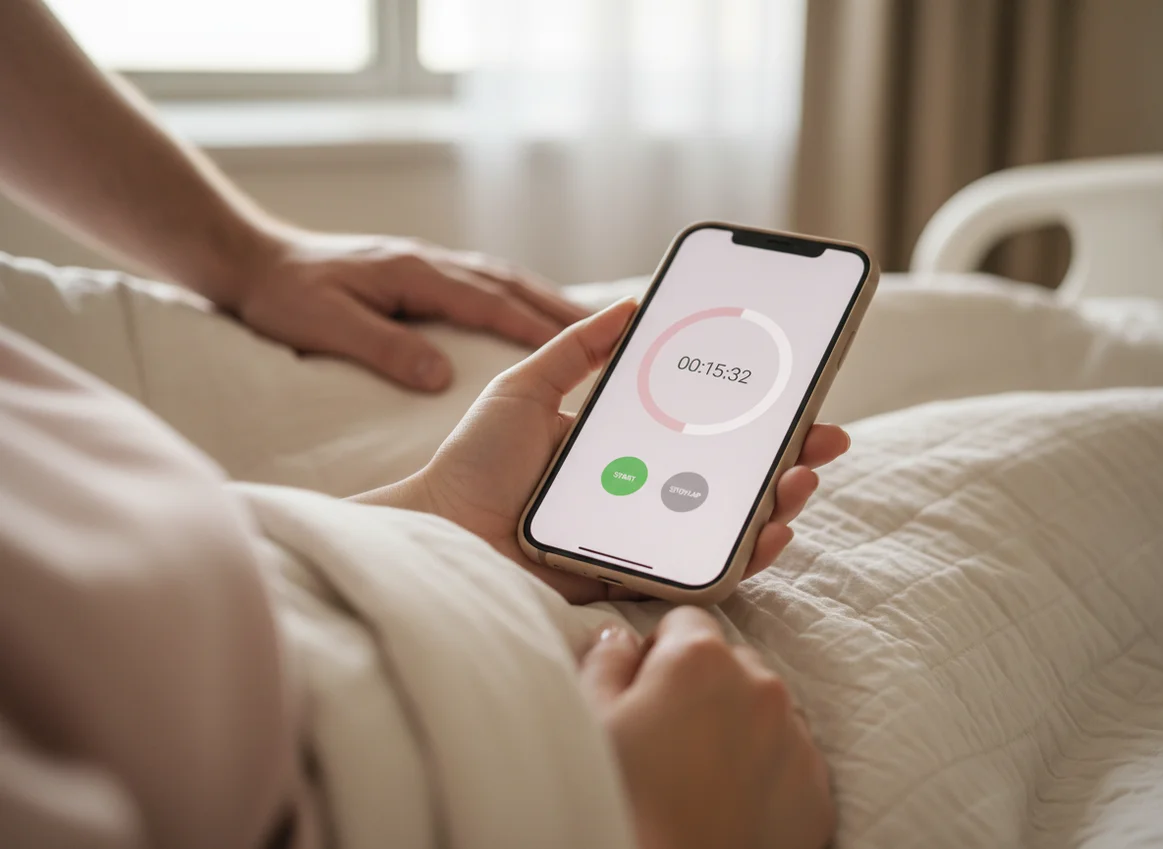
How to time contractions step by step
Timing contractions is simple, but consistency matters. Use the same start and stop points each time so your log shows a real pattern instead of guesswork.
- Press start when the contraction begins. This may feel like tightening, pressure, a wave in your abdomen, or discomfort that starts in your back.
- Press stop when the contraction ends. Stop when the tightness has faded and your uterus has fully softened.
- Let the timer calculate the interval. Frequency is measured from the start of one contraction to the start of the next.
- Record intensity if available. Marking contractions as mild, moderate, or strong can help show whether they are progressing.
- Track for about one hour. A single contraction does not tell you much; a pattern is more useful unless your provider told you to call sooner.
- Call your care team if the pattern matches their instructions or anything feels concerning.
If contractions are irregular and more than 8 minutes apart, you may be in early labor or experiencing Braxton Hicks contractions. Try resting, hydrating, changing position, and timing again if symptoms continue — unless your provider has given you different instructions.
The 5-1-1 rule for contractions
The 5-1-1 rule means contractions are about 5 minutes apart, each lasts about 1 minute, and the pattern continues for at least 1 hour. For many uncomplicated first labors, this is the point when parents are told to call the hospital, midwife, or birth center.
Some providers use a 4-1-1 or 3-1-1 guideline instead, especially if you have given birth before, live far from care, are planning a home birth transfer, or have medical considerations. Ask your doctor or midwife during pregnancy which guideline they want you to follow so you are not guessing during labor.
The NHS guidance on signs of labor notes that contractions become longer, stronger, and more frequent as labor progresses. For more detail, read our guide on when to go to the hospital during labor.
Braxton Hicks vs. real labor contractions
Braxton Hicks contractions are practice contractions. They often feel like tightening across your belly, are usually irregular, do not steadily intensify, and may ease with water, rest, walking, or changing position.
Real labor contractions tend to form a progressive pattern. They often become closer together, last longer, feel stronger, and become harder to talk through over time. A timer can make the pattern easier to see: Braxton Hicks may come at random intervals such as 12 minutes, then 6 minutes, then 20 minutes, while labor contractions often narrow from 8 minutes to 7, then 6, then 5.
Early labor can still be stop-start, and bodies are not machines. If you are unsure, time contractions for about an hour, compare your pattern with our Braxton Hicks vs. real contractions guide, and call your care team if anything worries you.
When to start timing contractions
Start timing when contractions feel different from your usual tightening, especially if they make you pause, require your attention, come with pelvic pressure or backache, or feel rhythmic and wave-like.
There is no harm in practicing before labor, particularly during the third trimester. Practicing during Braxton Hicks can help you learn the timer before contractions are intense.
Many first-time parents begin timing around 38 to 40 weeks because every new sensation feels important. Parents who have birthed before may wait until contractions feel clearly stronger or more organized. Early labor contractions are often 30 to 45 seconds long and may be 5 to 20 minutes apart; active labor contractions are commonly longer and closer together. Our stages of labor guide can help you interpret what your timing log may mean.
Contraction timer app features
The web timer above works well for quick tracking. A phone app may be easier during labor if you want saved history, intensity notes, partner-friendly tracking, and offline access.
- One-tap timing. A large start/stop button is easier to use during contractions.
- Automatic frequency calculation. The app calculates the start-to-start interval between contractions.
- Intensity logging. Mild, moderate, or strong notes can help show progression.
- Session history. A saved log helps you compare patterns across hours or days.
- 5-1-1 alerts. Some tools can notify you when contractions match the pattern your provider may ask about.
- Offline access. This can be useful in hospital rooms, birth centers, or areas with weak signal.
- Sharing options. Exporting a log can help your partner, doula, nurse, or provider review the pattern quickly.
The contraction timer is part of a broader pregnancy toolkit that includes a due date calculator, kick counter, and hypnobirthing audio sessions. You can also compare features in our contraction timer app guide and our labor tracking app comparison.
Best contraction tracking tools compared
The best contraction tracker is the one you can use consistently when labor feels intense. A simple web timer may be enough at home, while a phone app can be easier if you want saved history, intensity notes, and a shareable log.
| Tool | Best for | Notes |
|---|---|---|
| Pregnancy App | Contraction timing plus pregnancy and birth-prep tools | Includes timer options alongside broader pregnancy support. |
| Full Term | Simple contraction logging | Popular dedicated timer with basic history. |
| Contraction Timer & Counter 9m | Clear contraction counting | Designed around timing and hospital-readiness prompts. |
| Ovia Pregnancy | Pregnancy tracking plus extra tools | Broader pregnancy app with contraction features. |
Using contraction data during birth preparation
Contraction data is most useful when it supports your coping plan, not when it becomes another thing to panic over. Many parents find it grounding to pair timing with breathing, movement, warm water, counter-pressure, or calm verbal support.
During early labor, you may try dim lights, hydration, side-lying rest, slow breathing, or upright positions if they feel good. When a contraction starts, your support person can time while you focus on one cue, such as a long exhale. Practicing labor breathing exercises before contractions are strong can make the rhythm feel more familiar.
Frequently Asked Questions
When should I start timing contractions?
Start timing when contractions feel regular, different from your usual tightening, or strong enough that you need to pause and breathe through them. You can also practice earlier during Braxton Hicks contractions.
What does a contraction timer measure?
A contraction timer measures duration, frequency, count, and sometimes intensity. Duration is how long each contraction lasts from start to finish. Frequency is the time from the start of one contraction to the start of the next.
What is the 5-1-1 rule for contractions?
The 5-1-1 rule means contractions come about every 5 minutes, last about 1 minute, and continue for at least 1 hour. When your contractions match the guideline your provider gave you, call your provider, hospital, midwife, or birth center.
How do I tell the difference between Braxton Hicks and real contractions?
Braxton Hicks contractions are usually irregular, do not steadily get stronger, and may stop with rest, hydration, or changing position. Real labor contractions tend to follow a pattern, get stronger and closer together, and do not go away as easily.
How long should contractions last before going to the hospital?
Many providers use a pattern like 5-1-1, 4-1-1, or 3-1-1 rather than one contraction length alone. Follow your provider’s specific plan, especially if you live far from care, have given birth before, or have a high-risk pregnancy.
Can I use a contraction timer app during labor?
Yes. A contraction timer app can be one of the easiest ways to track contractions during labor. Many people have a partner or support person run the timer while they focus on breathing, movement, and coping.
How accurate are online contraction timers?
Online timers are usually precise, but the log depends on when someone presses start and stop. Human reaction time can add a small margin of error of a few seconds, which is usually acceptable for seeing an overall contraction pattern.
Is the contraction timer free?
Yes. The contraction timer on this page is free to use, and the Pregnancy App mobile contraction timer is also free to download.
Limitations & Safety
- A contraction timer is not a medical device. It cannot diagnose labor, confirm cervical dilation, predict delivery, or replace your provider’s advice.
- Do not wait for a contraction pattern if warning signs appear. Call your provider, labor ward, or emergency services for heavy bleeding, severe pain between contractions, fever, feeling faint, or anything that feels urgent.
- Water breaking may change your instructions. Follow your provider’s plan about when to call or come in, and mention fluid color, odor, and time your waters broke.
- Reduced baby movement needs prompt guidance. A baby kick counter may support awareness, but ACOG notes fetal movement changes should be discussed with a clinician.
- High-risk or preterm concerns need personalized care. Multiples, placenta concerns, hypertension, prior complications, or signs of preterm labor require your care team’s instructions over general timing rules.