 Pregnancy
3 Weeks Pregnant: What to Expect
Quick Answers at Week 3
At 3 weeks pregnant, the developing pregnancy is microscopic, and the main takeaway is that fertilization may have just happened while testing and symptoms are usually still unclear.
- Baby size: microscopic, smaller than a pinhead and not measurable on standard ultrasound
- Symptoms: often none, mild bloating, breast tenderness, light cramping, mood changes
- Appointments: usually not needed yet unless you have pain, heavy bleeding, fertility treatment, ectopic pregnancy history, chronic conditions, or medication questions
- Ultrasound: too early to see an embryo, heartbeat, placenta, or gestational sac
Week 3 at a Glance
| Topic | Week 3 |
|---|---|
| Baby size | Microscopic cluster of rapidly dividing cells, smaller than a pinhead |
| Ultrasound | No visible embryo, heartbeat, placenta, or gestational sac is expected yet |
| Symptoms | Often none; possible mild cramping, bloating, breast tenderness, or mood changes |
| Appointments | Routine prenatal care usually waits until after a positive test, unless there are risk factors or concerning symptoms |
| Key milestone | Fertilization may occur, followed by early cell division and movement toward implantation |
TL;DR
At 3 weeks pregnant, conception may have just happened, but the developing pregnancy is still microscopic and usually not detectable by ultrasound. Symptoms are often absent or vague, and pregnancy tests are usually more reliable after implantation and a missed period.
- Baby is a zygote, morula, or early blastocyst rather than a formed embryo.
- hCG may still be too low for a home pregnancy test.
- Start or continue folic acid and contact a clinician for severe pain, heavy bleeding, fainting, or medication concerns.
What does 3 weeks pregnant mean?
At 3 weeks pregnant, you are dated about three weeks from the first day of your last menstrual period, even though conception may have happened only recently. In a typical cycle, ovulation and fertilization often occur near this point, so 3 weeks gestation is still very early and may not feel different from an ordinary cycle.
If you are tracking dates, the pregnancy week-by-week guide can help you see where this stage fits, and a due date calculator can estimate timing from your last menstrual period. If ovulation happened earlier or later than expected, later dating may shift slightly.
Baby development at week 3
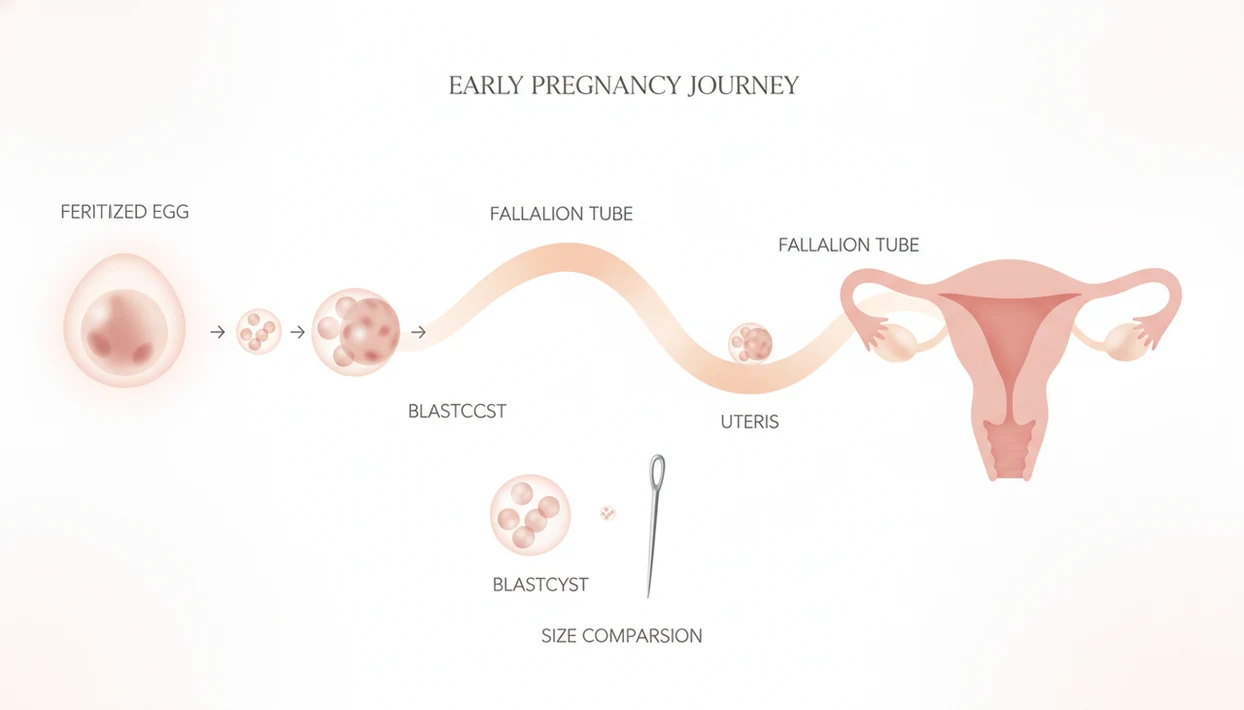
At week 3, the key development is possible fertilization, when a sperm joins an egg to form a single cell called a zygote. That cell begins dividing as it travels through the fallopian tube toward the uterus, becoming a morula and then an early blastocyst.
Research suggests that the genetic blueprint is set at fertilization, including chromosomes that influence inherited traits and chromosomal sex. There is not yet a formed baby, heartbeat, or functioning placenta; some cells will later contribute to the embryo, while others will help form pregnancy-supporting structures.
Implantation usually begins around the end of this week or early week 4, depending on ovulation timing. This is why early pregnancy week 3 can be biologically active even when there are no obvious signs.
How big is the baby at week 3?
At week 3, the developing pregnancy is microscopic, smaller than a pinhead, and too small to measure meaningfully on a standard ultrasound. It is more accurate to describe it as a cluster of dividing cells than as a baby with organs or visible features.
A fruit comparison is not very useful yet because the main change is cell division, not visible size. There is also no gestational sac expected on ultrasound at this stage, and an OB-GYN or midwife would not use an ultrasound now to confirm a normal early pregnancy unless there were special medical concerns.
What symptoms happen during early pregnancy week 3?
Symptoms at week 3 are often absent or indistinguishable from ovulation or premenstrual changes. Mild bloating, breast tenderness, light cramping, or mood shifts can happen, but these symptoms at week 3 cannot confirm pregnancy.
Many clinicians explain that hCG, the hormone most pregnancy tests detect, usually rises after implantation, so the body may not be producing enough yet to cause clear symptoms. Light spotting can occur around implantation for some people, but heavy bleeding or severe pain is not considered typical.
The waiting can feel exciting, uncertain, or surprisingly overwhelming, especially when every twinge seems important. For low-pressure support while you wait, gentle tools such as pregnancy meditation may help with stress without trying to diagnose what is happening.
Can you test or see anything on ultrasound this week?
This week, a home pregnancy test is often negative and an ultrasound is not expected to show a gestational sac, embryo, heartbeat, or placenta. Most home tests detect hCG after implantation, so testing is generally more reliable after a missed period or around week 4.
If you test early and the result is negative, it may simply be too soon. Many clinicians suggest retesting after 48 hours or after a missed period, ideally with first-morning urine, because hCG tends to become easier to detect after implantation progresses.
A digital pregnancy tracker can help you record dates, possible ovulation, symptoms, and testing windows. If you are pregnant 3 weeks by last menstrual period dating, a negative test does not necessarily rule out pregnancy.
What should you do at week 3 and what comes next?
This week, the most useful steps are to take folic acid or a prenatal vitamin, avoid alcohol and smoking, review medicines if pregnancy is possible, and expect implantation and clearer testing to come next. ACOG and NHS guidance commonly emphasizes folic acid before and during early pregnancy to support early development.
Most people do not need a routine prenatal appointment yet unless they have concerning symptoms, fertility treatment, a history of ectopic pregnancy, chronic health conditions, or questions about medications or supplements. Many clinicians schedule the first routine visit after a positive test, often later in the first trimester, depending on local practice.
If you want to prepare without getting ahead of yourself, the best pregnancy app guide may be useful for tracking and education. Later tools such as the contraction timer are worth saving for the third trimester rather than this stage.
Limitations & Safety
The main safety limitation at this stage is that symptoms, dates, and tests can be unclear because implantation and hCG rise may not be complete. This page is general education and cannot diagnose pregnancy, miscarriage, ectopic pregnancy, or any medical condition.
- Seek urgent medical care for severe abdominal or pelvic pain, heavy bleeding, shoulder pain, fainting, or dizziness.
- Contact an OB-GYN, midwife, or healthcare professional early if you have a history of ectopic pregnancy, fertility treatment, chronic illness, or medication concerns.
- Follow local clinical advice about prenatal vitamins, folic acid dose, testing timing, and appointment scheduling.
- Do not rely on symptoms alone to confirm or rule out pregnancy during week 3.
Frequently Asked Questions
Can you know you are pregnant at 3 weeks pregnant?
Usually, you cannot know for sure this early unless testing later confirms it or you are being closely monitored during fertility treatment. Many clinicians note that hCG may still be too low for home tests before implantation is complete.
What symptoms are normal at week 3?
No symptoms are common at week 3, and mild bloating, breast tenderness, light cramping, or mood changes may also be normal. These signs overlap with ovulation and the premenstrual phase, so they are not reliable proof of pregnancy.
How big is the baby at 3 weeks?
The developing pregnancy is microscopic and smaller than a pinhead at this stage. It is a cluster of rapidly dividing cells, not a visible embryo with organs or features.
Should I book a prenatal appointment this early?
Most routine prenatal visits are not booked this early unless there are medical concerns. Call an OB-GYN, midwife, or clinician sooner for severe pain, heavy bleeding, fertility treatment, ectopic pregnancy history, chronic conditions, or medication questions.
Can a pregnancy test be positive at 3 weeks pregnant?
It can happen near the end of the week with a very sensitive test, but a negative result is common and does not rule out pregnancy. Testing after a missed period is usually more reliable because hCG rises after implantation.
Is cramping or spotting normal at 3 weeks gestation?
Mild cramping or very light spotting can occur, especially around ovulation or possible implantation. However, ACOG and NHS guidance commonly advises urgent care for severe one-sided pain, heavy bleeding, shoulder pain, dizziness, or fainting.