 Pregnancy
Contraction Timer, track labor contractions.
You can time your contractions for free. Track the duration, frequency, and intensity. It can help you know when it’s time to go to the hospital.
Contraction Timer
What is a contraction timer?
A contraction timer tracks how long each contraction lasts. It also tracks how much time passes between contractions. It measures two things: duration (start to finish of a single contraction) and frequency (start of one contraction to the start of the next). These two numbers help your doctor or midwife gauge how far labor has progressed.
Honestly, you don’t need anything fancy for this. A clock, a phone stopwatch, or a tool like the one above all work. The point is consistency — pressing start when the tightening begins and stop when it fades. Your partner, doula, or support person can operate the timer while you focus on breathing through contractions.
Most hospitals ask for contraction data when you call or arrive at triage. A clear log of your contraction timing saves time. It helps the staff figure out if you’re in early labor or active labor.
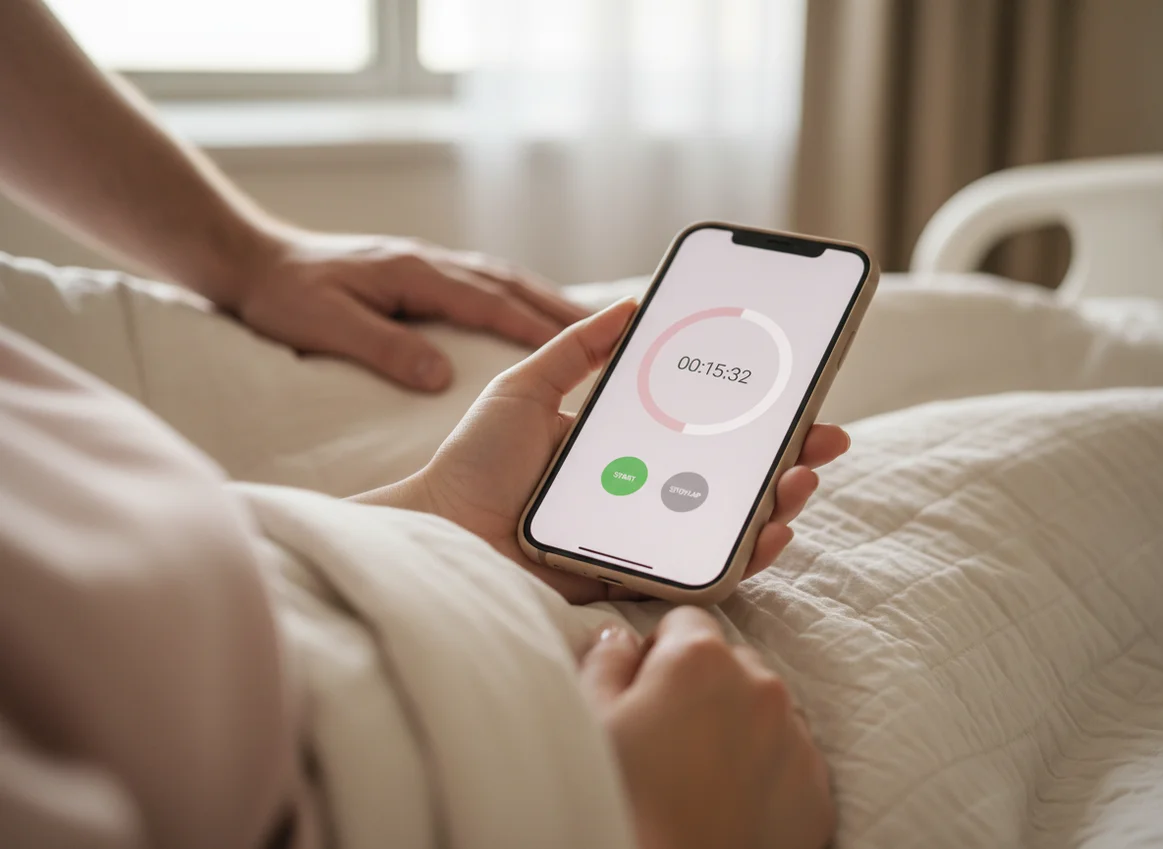
How to Time Contractions: Step by Step
Timing contractions is straightforward once you understand what to record. Here's the process:
- Press start when the contraction begins. You’ll feel your uterus tighten. It often starts as a wave of pressure in your lower back or your abdomen.
- Press stop when the contraction ends. The tightness will peak, then it’ll gradually fade. Stop the timer when the muscle fully relaxes.
- Wait for the next contraction. The timer records the gap automatically. This interval — from the start of one contraction to the start of the next — is the frequency.
- Repeat for at least one hour. A single contraction tells you very little. You need a pattern. Track for 60 minutes minimum before making any decisions.
- Note the intensity. Some timers let you record whether each contraction felt mild, moderate, or strong. This helps you spot the progression from early labor to active labor.
If contractions are irregular and more than 8 minutes apart, you are likely in early labor or experiencing Braxton Hicks contractions. Try resting and drinking water. Then time again in an hour.
The 5-1-1 Rule, when to go to the hospital.
The 5-1-1 rule is the most widely taught guideline for knowing when to head to the hospital. It means contractions come every 5 minutes, each lasts 1 minute, and this pattern continues for at least 1 hour.
When your contraction timer shows a consistent 5-1-1 pattern, call your provider. They may tell you to come in or wait a bit longer depending on factors like how far you live from the hospital, whether this is your first baby, and your medical history.
Some providers use a 4-1-1 or 3-1-1 rule instead, especially for second-time mothers whose labor tends to progress faster. Ask your doctor or midwife at a prenatal visit which guideline they want you to follow. That way, you’re not guessing at 2 a.m.
The 5-1-1 rule applies to uncomplicated pregnancies. If your water breaks, you experience heavy bleeding, or your baby's movement decreases, go to the hospital immediately — regardless of what the contraction timer shows. Read more about when to go to the hospital during labor.
Braxton Hicks vs. Real Contractions
Braxton Hicks contractions are practice contractions. They feel like a tightening across your belly. They’re usually irregular. They don’t get stronger over time. They usually stop if you change position, walk around, or drink a glass of water.
Real labor contractions follow a predictable pattern. Real contractions usually get closer together, last longer, and feel stronger each time. A contraction timer can make the difference pretty obvious. Braxton Hicks contractions often come at random intervals (12 minutes, then 6, then 20). Real contractions usually settle into a narrowing pattern (8 minutes, then 7, then 6, then 5).
If you're unsure, time them for an hour. Braxton Hicks fade. Real contractions don't. That hour of data on your timer is the single most useful thing you can bring to your phone call with the labor ward. For a detailed comparison, see our guide on Braxton Hicks vs. real contractions.
When to Start Timing Contractions
Start timing when you notice contractions that feel different from what you've been experiencing. For a lot of women, it means contractions that make you stop what you’re doing. You can’t comfortably talk through them.
There's no such thing as timing too early. Practicing with the timer during Braxton Hicks in the weeks before labor is actually helpful. If you practice timing early, you’ll know the interface. You’ll probably feel less anxious about how it works. You’ll be able to spot real labor patterns faster when they start.
First-time mothers often start timing around 38–40 weeks when any tightening feels significant. Experienced mothers may wait until contractions feel unmistakably different from the Braxton Hicks they've been having for weeks. Honestly, both ways are fine.
Understanding the stages of labor helps you interpret what the timer is telling you. Early labor contractions are typically 30–45 seconds long. Early labor contractions are typically 5–20 minutes apart. Active labor contractions last 45–60 seconds and come every 3–5 minutes.
Contraction Timer App Features
The web timer above works well for quick tracking. For a full-featured experience during labor, the Pregnancy App contraction timer on your phone offers several advantages:
- One-tap timing. Large start/stop button designed for use during contractions when fine motor control is limited.
- Automatic frequency calculation. The app calculates intervals between contractions in real time.
- Intensity logging. Write down whether each contraction feels mild, moderate, or strong, so you can track progression.
- Session history. Review past timing sessions to compare patterns across hours or days.
- 5-1-1 alert. Get a notification when your contractions match the hospital-ready pattern.
- Works offline. No internet required — critical for hospital rooms and birth centers with weak signal.
- Share with your partner. Export your contraction log to show your support team or provider.
The contraction timer is part of a broader pregnancy toolkit that includes a due date calculator, kick counter, and hypnobirthing audio sessions. Everything is free.
TL;DR
- A contraction timer tracks duration (how long) and frequency (how far apart).
- Use the 5-1-1 rule: every 5 minutes, lasting 1 minute, for 1 hour — then call your provider.
- Braxton Hicks are irregular and fade with rest. Real contractions get stronger and closer together.
- Start timing when contractions are strong enough that you have to stop and breathe through them.
- Always go to the hospital immediately if your water breaks. Always go to the hospital immediately if you bleed heavily. Always go to the hospital immediately if your baby stops moving, no matter how you’ve been timing things.
Limitations & Safety
This contraction timer is an informational tool, not a medical device. It does not diagnose labor, predict delivery, or replace professional medical advice. The accuracy of the data depends entirely on when you press start and stop — human reaction time introduces a margin of error of a few seconds per contraction.
Do not rely solely on a contraction timer to decide when to go to the hospital. Other signs of labor can matter just as much. These signs include your water breaking. These signs include bloody show. These signs include decreased fetal movement. These signs include that gut feeling that something’s wrong. These signs may require immediate medical attention even if contractions are not following the 5-1-1 pattern.
If you have a high-risk pregnancy, preterm labor concerns, or any condition your provider has flagged, follow their instructions instead of general guidelines. Call your doctor or midwife anytime you’re unsure. When in doubt, go in. No one at the hospital is going to fault you for showing up early.
Frequently Asked Questions
When should I start timing contractions?
Start timing contractions once they’re regular and strong enough that you can’t talk or walk through them. For most first-time mothers, this happens during active labor when contractions are coming every 5–7 minutes. And honestly, there’s no harm in starting early if you just want to practice using the timer.
What’s the 5-1-1 rule for contractions?
The 5-1-1 rule means contractions come every 5 minutes. Each contraction lasts 1 minute. This pattern continues for at least 1 hour. When your contractions match this pattern, it’s usually time to call your provider or head to the hospital. Some providers use the 4-1-1 guideline instead. Some providers use 3-1-1.
How do I tell the difference between Braxton Hicks and real contractions?
Braxton Hicks contractions are irregular. They don’t get stronger over time. They usually stop if you change positions or drink water. Real labor contractions follow a pattern, get progressively stronger and closer together, and do not go away with rest or hydration.
How long should contractions last before you go to the hospital?
Most providers recommend going to the hospital when your contractions are consistently 5 minutes apart. Each contraction lasts 60 seconds. This pattern continues for at least 1 hour. If your water breaks, go immediately, no matter what your contraction timing looks like. If you have heavy bleeding, go immediately. If the baby stops moving, go immediately.
What does a contraction timer measure?
A contraction timer measures duration (how long each contraction lasts from start to finish). It measures frequency. Frequency is the time from the start of one contraction to the start of the next. It measures count (total number of contractions tracked). Some timers also let you log intensity.
Can I use a contraction timer app during labor?
Yes. A contraction timer app on your phone is one of the easiest ways to track contractions during labor. In my experience, a lot of women have a partner run the timer while they focus on breathing and coping techniques. The Pregnancy App contraction timer works on both iOS and Android.
How accurate are online contraction timers?
Online contraction timers are as accurate as the person pressing the buttons. The timer itself is precise, but human reaction time introduces a small margin of error — typically a few seconds. This is accurate enough for clinical decision-making about when to go to the hospital.
Is the contraction timer free?
Yes. The contraction timer on this page and in the Pregnancy App mobile app is completely free. There are no paywalls, ads, or account requirements. You can start timing contractions immediately.